

BALTIC STUDENT CONFERENCE BRIDGES IN THE BALTICS
Warsaw 2026
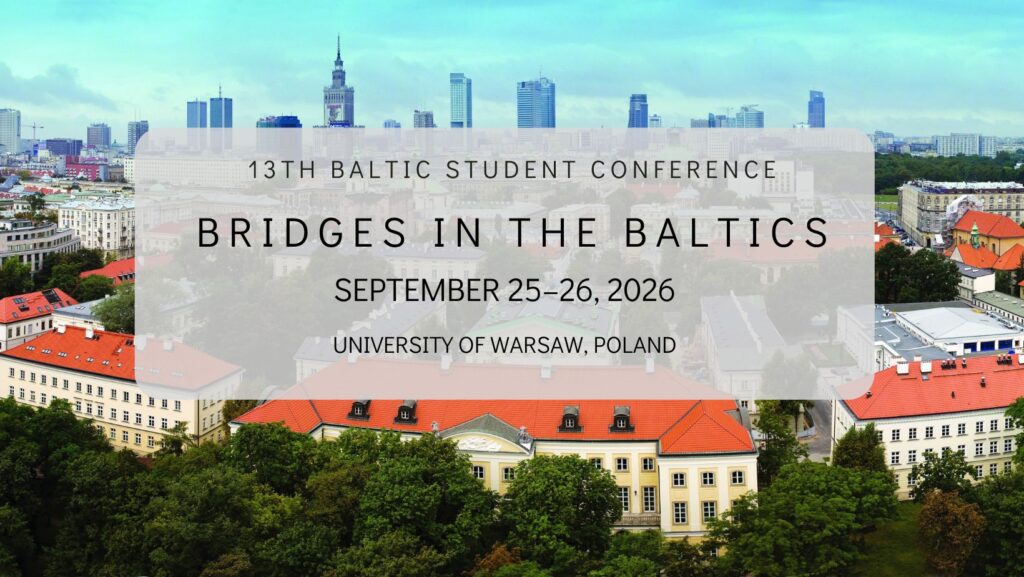
The 13th Baltic Student Conference “Bridges in the Baltics” will be organized by the The Subdepartment of Baltic Studies at the University of Warsaw and will take place in on September 25-26, 2026.
The aim of the conference is to bring together students whose studies and research are related to the languages and cultures of the three Baltic States. It offers an opportunity to present academic work, exchange ideas with fellow students from other universities and countries, and establish new contacts across the region and beyond.
We invite everyone who is currently pursuing a Bachelor´s, Master´s or PhD degree concerning Baltic studies. The conference welcomes proposals addressing any of the following aspects of the society and culture of the Baltic countries:
- language and literature;
- literature, folklore, and arts;
- cultural and biographical studies;
- media, film and communication;
- history and memory.
The working languages of the conference are Estonian, Latvian, Lithuanian and English. Everyone is welcome to give their presentation in any language mentioned above; however, your abstract and slides should be in English.
PROGRAMME (updated September 21)
BOOK OF ABSTRACTS (updated September 21)
Plenary speakers
IEVA SPOLĪTE, MA, Latvia and Estonia – different yet alike

Ieva Spolīte-Jansone is a lecturer of Estonian language at the University of Latvia under the EKKAV program. EKKAV is a project financed by the Estonian state sending Estonian language and culture lecturers to various universities across Europe. She completed her Bachelor’s in ethnology at the University of Tartu and later on earned a Master’s degree in pedagogy from Tallinn University. Whilst living in various countries, due to her family’s diplomatic background, Ieva Spolīte-Jansone promoted both Latvian and Estonian culture. She fostered the development of the Latvian diaspora notably by organising the Latvian European Summer School for children of the Latvian diaspora. Due to her continuous engagement in the advocation of Baltic heritage Ieva Spolīte-Jansone was awarded the medal of the Baltic Assembly in 2019.
MĀRTIŅŠ KAPRĀNS, PhD, The Transformation of Russophone Identity in the Baltic States after 2022

Mārtiņš Kaprāns is a senior researcher at the University of Latvia’s Institute of Philosophy and Sociology. He earned his PhD in Communication Science from the same university in 2012 and has since led or contributed to large-scale research projects on Baltic labour migration, Russophone communities in the Baltic states, oppositional agency in Soviet-occupied Latvia, and contemporary memory politics. He is the author or co-author of monographs on the commemoration of Soviet deportations in Latvia (2012), Latvian labour migrants in the UK (2023), and resistance and power relations in Soviet-occupied Latvia (2026). In 2024–25, Kaprāns was a Fulbright Visiting Scholar at Harvard University’s Davis Center for Russian and Eurasian Studies. His articles have appeared in Nationalities Papers, Journal of Ethnic and Migration Studies, Journal of Baltic Studies, Europe-Asia Studies, and Memory Studies.
AKVILĖ RĖKLAITYTĖ, PhD, On Soviet humanism: The ethos of “Kindness” in late Soviet Lithuanian literature

Dr. Akvilė Rėklaitytė is a literary scholar and Head of the Department of Contemporary Literature at the Institute of Lithuanian Literature and Folklore. She is the author of the monograph “Meistraujantis žmogus: Marcelijaus Martinaičio poetinė antropologija” (2020). Her research interests include literature and poetry of the second half of the 20th century, particularly the Soviet period, as well as contemporary literature and cultural theory. She is currently working on a research project on Lithuanian poetry of the 1980s (2025–2028).
MARCIN BĘDKOWSKI, PhD, Are Large Language Models Stochastic Parrots?

Dr Marcin Będkowski is an assistant professor at the University of Warsaw’s Institute of Polish Language, where he serves as Head of the Department of Computational Linguistics. He is also a data scientist at the Educational Research Institute – National Research Institute. His experience includes 14 national and international projects focusing on computational linguistics, labour market intelligence, logic, methodology, and education. He has authored or co-authored over 40 papers and monographs, with publications in journals such as Informal Logic, History and Philosophy of Logic, Synthese, Res Rhetorica, and Semiotic Studies, among others.
See you in Warsaw!
Contact:
balticbridges2026@gmail.com
https://sisu.ut.ee/balticbridge
Facebook: BRIDGES IN THE BALTICS
