Õppekavaarendus Tartu Ülikoolis
Process
Goal-oriented curriculum development requires substantive input from academic units and the active involvement of teaching staff. The process takes time – reaching agreement on changes, thinking them through, and achieving alignment can be challenging, particularly as attention must be paid to multiple aspects.
- Establishing the curriculum team and planning the change process. As large‑scale curriculum development represents a significant change, it must be managed deliberately. Key elements include a shared vision and awareness of the need for change, forming and leading the development team, setting interim goals and celebrating small wins, overcoming obstacles, and ensuring consistency in implementing change. In addition to the core curriculum development team, it is important to consider feedback from students, employers, and alumni, as well as international developments. The aim is to agree on curriculum‑wide teaching principles. These processes are described in more detail in stages 1 and 2.
- Rethinking the objective and learning outcomes of the curriculum. At this stage, attention should be paid to the development of students’ competences across semesters. Achieving vertical coherence within the curriculum is essential: alignment between the learning outcomes of courses and modules, between the learning outcomes of modules and the curriculum, and ensuring opportunities for student mobility within the curriculum. These processes are described in more detail in stages 3 and 4.
- Analysis and development of courses. Course learning outcomes are aligned with the development of students’ competences across semesters, including the review of the sequence and volume of compulsory courses. At the same time, horizontal coherence of the curriculum is developed: teaching and assessment methods are diverse, aligned with the curriculum’s teaching principles, and support the development of students’ skills and the attainment of learning outcomes; consideration is also given to the use of AI and to research-based teaching approaches.
For the new version of a curriculum for 2027/28 to apply to newly admitted students, the changes must be approved by 15 April 2027.
Countdown
Time until the deadline for approving changes:
Outputs:
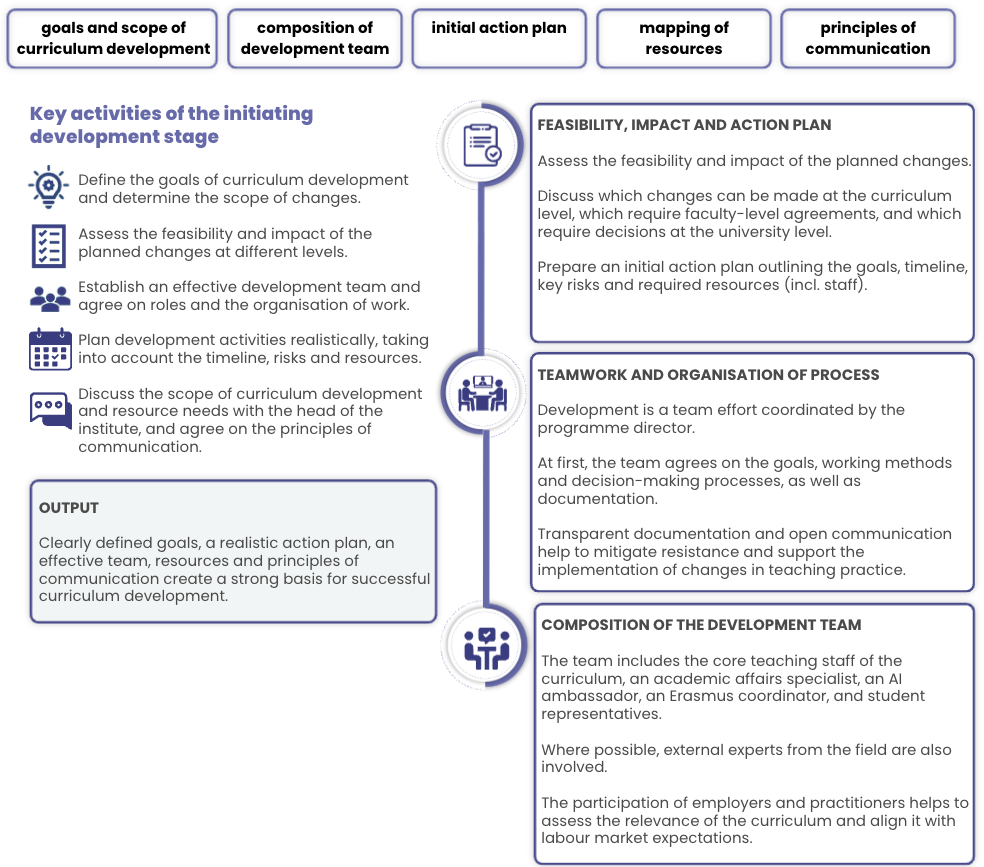
- goals and scope of curriculum development
- composition of the development team
- initial action plan
- mapping of resources
- principles of communication
Key activities at this stage:
- define the goals of curriculum development and determine the scope of changes;
- assess the feasibility and impact of the planned changes at different levels;
- establish an effective development team and agree on roles and the organisation of work;
- plan development activities realistically, taking into account the timeline, risks and resources;
- discuss the scope of curriculum development and resource needs with the head of the institute, and agree on the principles of communication.
At the stage of initiating development, it is important to assess the feasibility and expected impact of the planned changes. This involves discussing which changes can be made at the curriculum level, which require faculty‑level agreements, and which require decisions at the university level. To support this, it is useful to prepare an initial action plan outlining the goals, timeline, key risks and required resources (incl. staff). Academic developers of the Centre for Learning and Teaching can support the drafting of the action plan and the design of development seminars.
Purposeful curriculum development is a team effort that requires the involvement of diverse perspectives and competences. The process is led by the programme director, whose role is to coordinate collaboration and maintain focus on the curriculum’s integrity, coherence and learner‑centred approach. It is important, at the outset, to agree clearly on the goals, working methods, and decision‑making processes. It is also essential to document the development process. Transparent documentation and open communication throughout the process help to mitigate resistance to change and support the implementation of planned changes in actual teaching practice.
An effective development team includes the core teaching staff of the curriculum, who are responsible for course content and the attainment of learning outcomes, and shape teaching and assessment methods. Where possible, external experts from the field should also be involved. The participation of employers and practitioners helps assess the curriculum’s relevance and align it with labour market expectations. In addition, the development team is supported by an academic affairs specialist, an AI ambassador, an Erasmus coordinator, and student representatives.
Outputs:
- a consolidated analysis of how the curriculum functions
- development objectives and priorities
- mapping of the student learning pathway
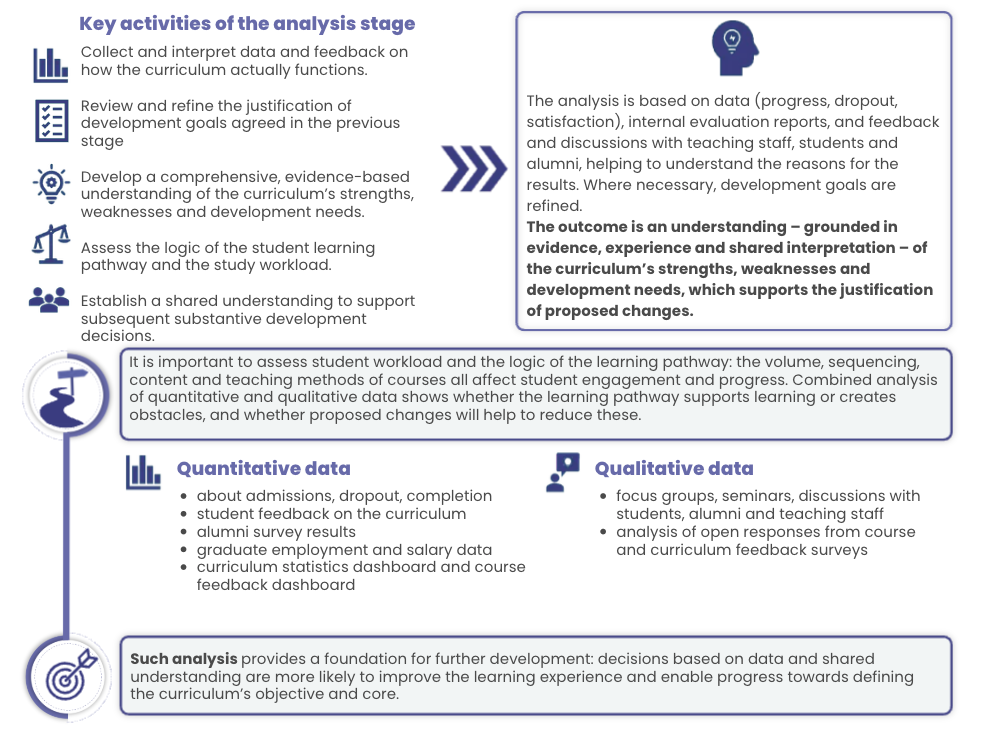
Key activities at this stage:
- collect and interpret data and feedback on how the curriculum actually functions;
- review and refine the development objectives agreed in the previous stage;
- develop a comprehensive, evidence‑based understanding of the curriculum’s strengths, weaknesses and development needs;
- assess the logic of the student learning pathway and the study workload;
- establish a shared understanding to support subsequent substantive development decisions.
The analysis is based on data (progress, dropout, satisfaction), internal evaluation reports, and feedback and discussions with teaching staff, students and alumni. Where necessary, development goals are refined. The outcome is an understanding – grounded in evidence, experience and shared interpretation – of the curriculum’s strengths, weaknesses and development needs, which supports the justification of proposed changes.
It is important to assess student workload and the logic of the learning pathway: the volume, sequencing, content and teaching methods of courses all affect student engagement and progress. A combined analysis of quantitative and qualitative data shows whether the learning pathway supports learning or creates obstacles, and whether proposed changes will help reduce them.
For the analysis, quantitative datasets can be drawn from course feedback dashboards and curriculum statistics dashboards, including admissions data, dropout and completion rates, student feedback on the curriculum, alumni survey results, and graduate employment and salary data. Equally important are qualitative methods: focus groups, seminars and discussions with students, alumni and teaching staff, as well as analysis of open responses from course and curriculum feedback surveys.
Such analysis provides a foundation for further development: decisions based on data and shared understanding are more likely to improve the learning experience and enable progress towards defining the curriculum’s objective and core.
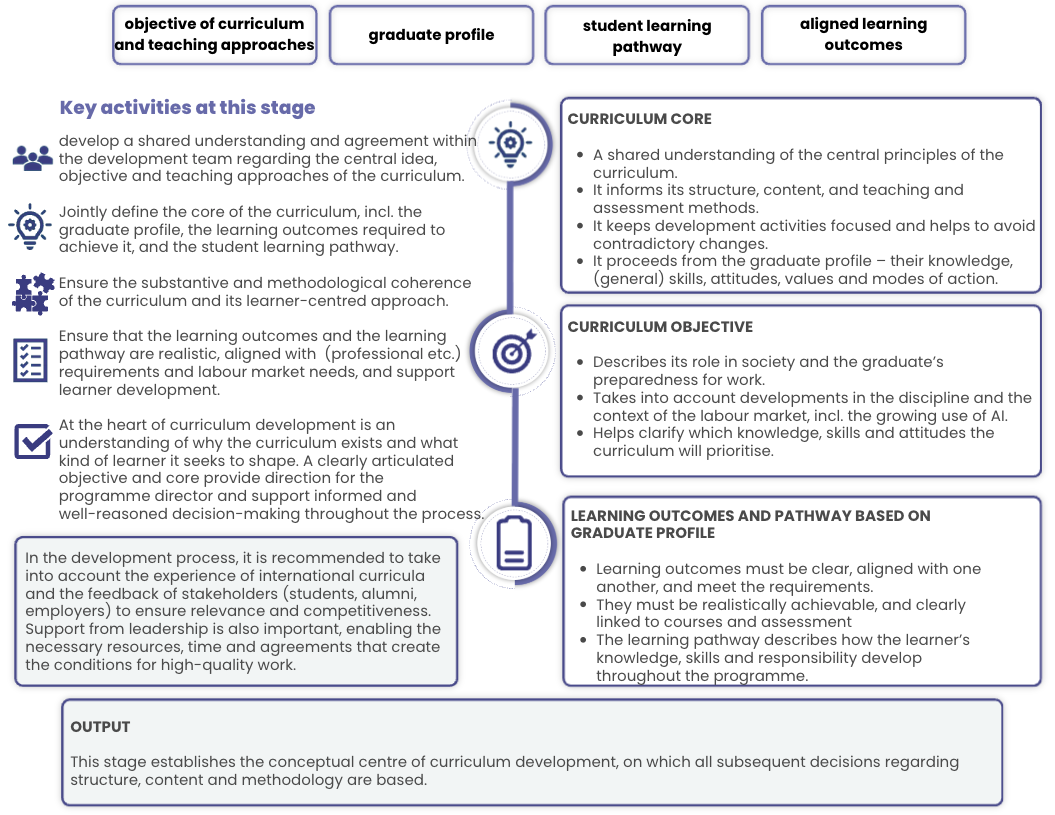
Outputs:
- the objective of the curriculum and teaching approaches
- graduate profile
- student learning pathway
- aligned learning outcomes
Key activities at this stage:
- develop a shared understanding and agreement within the development team regarding the central idea, objective and teaching approaches of the curriculum;
- jointly define the core of the curriculum, incl. the graduate profile, the learning outcomes required to achieve it, and the student learning pathway;
- ensure the substantive and methodological coherence of the curriculum and its learner‑centred approach;
- ensure that learning outcomes are achievable, aligned with requirements and labour market needs, and support learner development.
At the heart of curriculum development is an understanding of why the curriculum exists and what kind of learner it seeks to shape. A clearly articulated objective and core provide direction for the programme director and support informed and well‑reasoned decision‑making throughout the process.
The core of the curriculum is a shared understanding that informs its structure, content, and teaching and assessment methods. To establish this, it is important to organise development seminars in which teaching staff jointly formulate and discuss the main idea of the curriculum. A shared understanding supports consistent action, keeps development activities focused, and helps to avoid contradictory changes. At the centre of this core is the graduate profile – a description of the graduate’s knowledge, (general) skills, attitudes, values and modes of action. This provides teaching staff with a common foundation for development and helps to assess whether the courses in the curriculum support the intended development.
The objective of the curriculum describes its role in society and the graduate’s preparedness for work, taking into account developments in the discipline and the context of the labour market, incl. the growing use of AI. A well‑formulated objective helps clarify which knowledge, skills and attitudes the curriculum will prioritise.
Learning outcomes depend on the graduate profile. They must be clear, aligned with one another, realistically achievable, and clearly linked to courses and assessment. The student learning pathway is also essential: how the learner’s knowledge, skills and responsibility develop throughout the programme. A clearly defined objective and core provide the foundation for further development, as they help to evaluate changes, explain decisions, and maintain a focus on learner development. The ability to explain the core concisely and clearly is a precondition for meaningful development.
In the development process, it is recommended to take into account the experience of international curricula and the feedback of stakeholders (students, alumni, employers) to ensure relevance and competitiveness. Support from leadership is also important, enabling the allocation of necessary resources and time, and facilitating agreements that create the conditions for high‑quality work.
This stage establishes the conceptual centre of curriculum development, on which all subsequent decisions regarding structure, content and methodology are based.
Outputs:
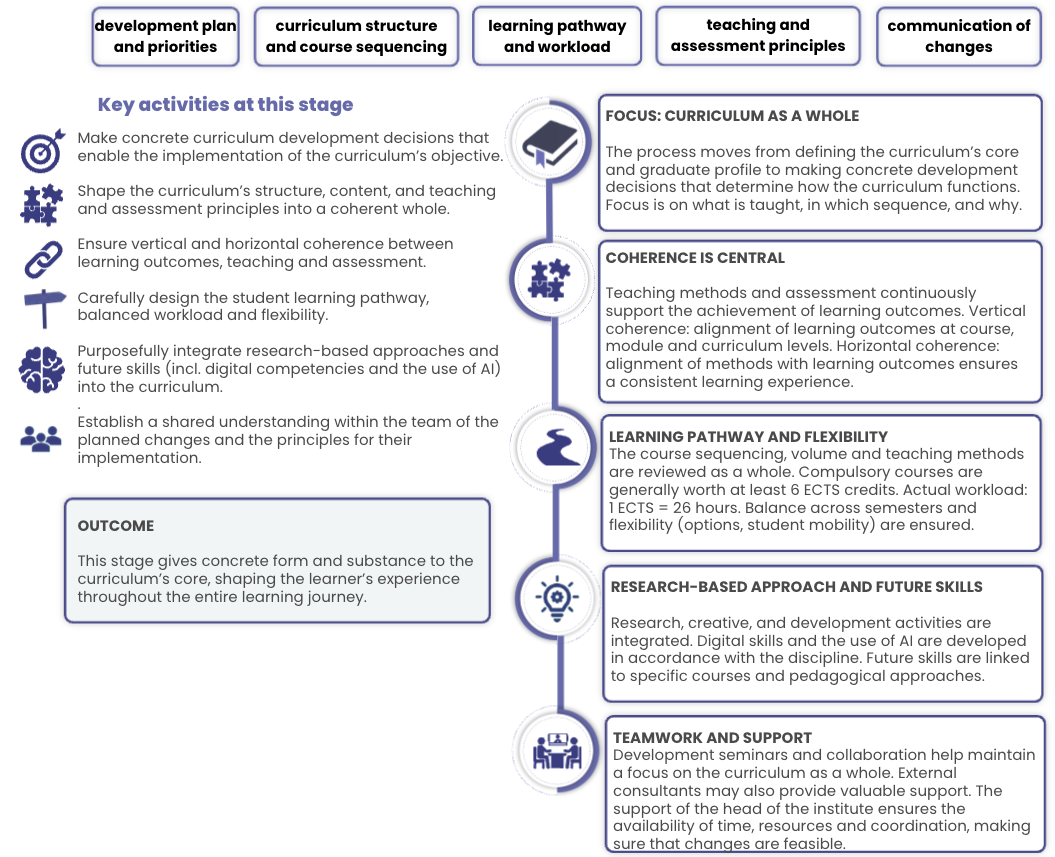
- development plan and priorities
- curriculum structure and course sequencing
- student learning pathway and workload
- teaching and assessment principles
- communication of changes
Key activities at this stage:
- make concrete curriculum development decisions that enable the implementation of the curriculum’s objective;
- shape the curriculum’s structure, content, and teaching and assessment principles into a coherent whole;
- ensure vertical and horizontal coherence between learning outcomes, teaching and assessment;
- carefully design the student learning pathway, balanced workload and flexibility;
- purposefully integrate research‑based approaches and future skills (incl. digital competencies and the use of AI) into the curriculum;
- establish a shared understanding within the team of the planned changes and the principles for their implementation.
At the stage of planning and implementing development directions, the process moves from defining the curriculum’s core and graduate profile to making concrete development decisions that determine how the curriculum functions. The focus is on the curriculum as a whole – what is taught, in what sequence, and why – rather than on isolated changes to individual courses.
Coherence is the foundation of curriculum development: teaching methods and assessment support the achievement of learning outcomes and guide learners towards their goals. Vertical coherence refers to the alignment of learning outcomes at course, module and curriculum levels. This helps to assess learner development and avoid gaps and duplication. Horizontal coherence refers to the alignment of teaching and assessment methods with learning outcomes, ensuring a consistent and supportive learning experience.
The student learning pathway is reviewed as a whole: course sequencing, volume and teaching methods. Compulsory courses are generally worth at least 6 ECTS credits. The actual workload within courses is also assessed (1 ECTS = 26 hours) to ensure balance across semesters. The curriculum should be sufficiently flexible, allowing for individual choices and student mobility.
Research, creative and development activities are integrated into the curriculum. The development of digital skills and the use of AI are also planned in accordance with the discipline: required competences are defined, along with appropriate teaching and assessment methods. The development of future skills is linked to specific courses and pedagogical approaches.
Successful implementation at this stage once again depends on teamwork: development seminars and collaboration help maintain a focus on the curriculum as a whole. External consultants may also provide valuable support. The support of the head of the institute ensures the availability of time, resources and coordination, helping to align development activities with broader objectives and ensuring that changes are feasible.
This stage gives concrete form and substance to the curriculum’s core, shaping the learner’s experience throughout the entire learning journey.
Outputs:
- a curriculum version ready for approval
- a comparison table of curriculum learning outcomes with the HES
Key activities at this stage:
- verify (preferably in consultation with the Office of Academic Affairs) that the updated curriculum learning outcomes are aligned with the higher education standard;
- prepare a version of the curriculum for approval by the faculty council;
- compile a comparison table aligning the curriculum learning outcomes with the higher education standard.
Updating curriculum learning outcomes constitutes a substantive change that must be reflected in the national curriculum register. Although changes are developed and agreed within the curriculum team, their implementation requires approval at several levels, as well as final endorsement from the Ministry of Education and Research’s committee for the classification and compliance assessment of higher education curricula and programmes.
For the curriculum version to take effect in a given academic year, it must be finalised and approved by 15 April.
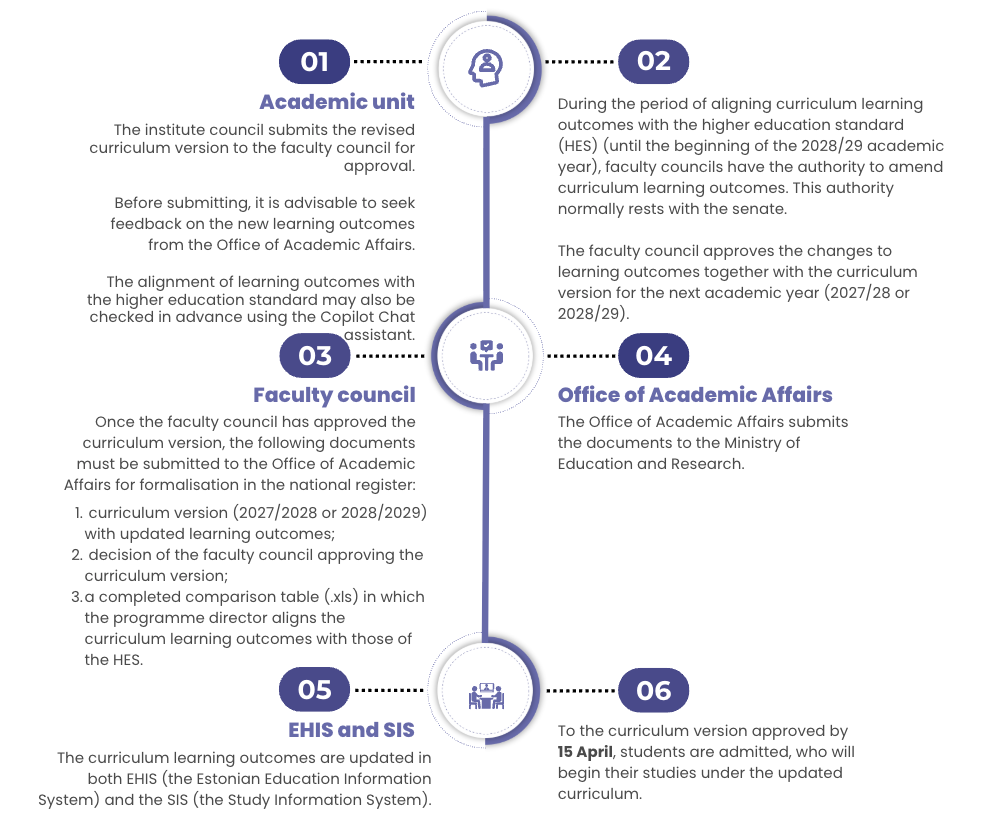
- The council of the academic unit submits the revised curriculum version to the faculty council for approval. During the period of aligning curriculum learning outcomes with the higher education standard (until the beginning of the 2028/29 academic year), faculty councils have the authority to amend curriculum learning outcomes. Normally, this authority rests with the senate.
- The faculty council approves the changes to learning outcomes together with the curriculum version for the next academic year (2026/27, 2027/28 or 2028/29). Before submitting the revised outcomes to the faculty council, it is advisable to seek feedback from the Office of Academic Affairs (whether all required competences are covered and whether the action verbs correspond to the level of study). The alignment of learning outcomes with the higher education standard may also be checked in advance using the Copilot Chat assistant;
- Once the faculty council has approved the curriculum version, the following documents must be submitted to the Office of Academic Affairs for formalisation in the national register:
- the curriculum version (2026/27, 2027/28 or 2028/29) with updated learning outcomes;
- the decision of the faculty council approving the curriculum version;
- a completed comparison table (.xls) in which the programme director aligns the curriculum learning outcomes with those of the higher education standard.
- The Office of Academic Affairs submits the documents to the Ministry of Education and Research.
- The curriculum learning outcomes are updated in both EHIS (the Estonian Education Information System) and the SIS (the Study Information System).
- To the curriculum version approved by 15 April, students are admitted, who will begin their studies under the updated curriculum.
Outputs:
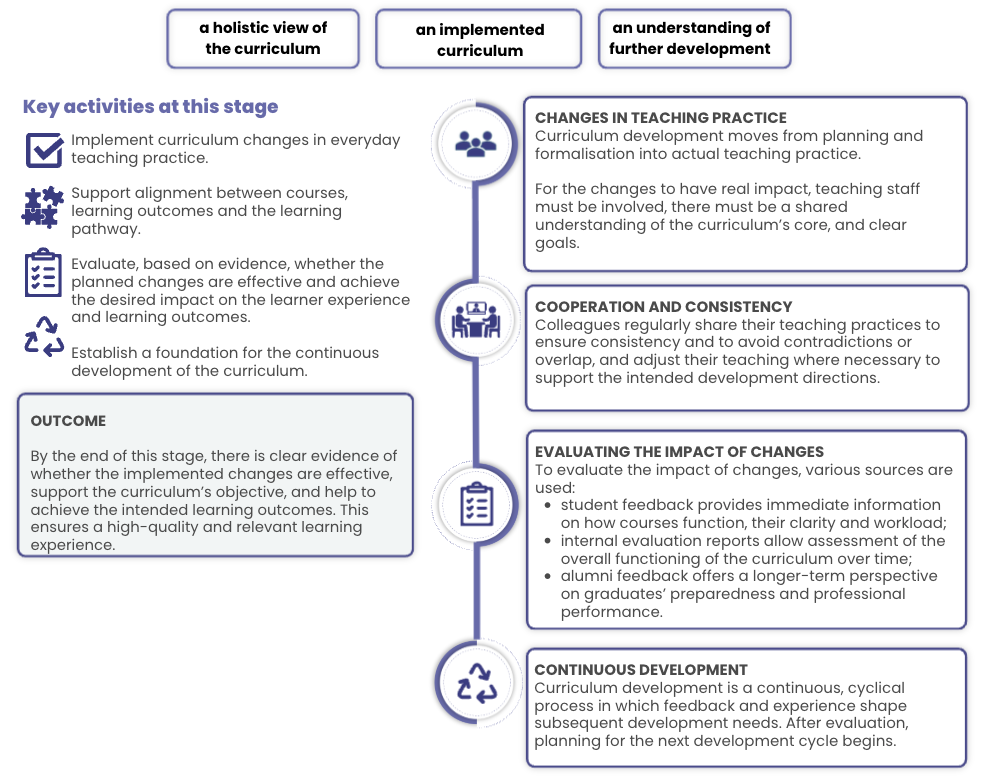
- a holistic view of the curriculum
- an implemented curriculum
- an understanding of further development needs
Key activities at this stage:
- implement curriculum changes in everyday teaching practice;
- support alignment between courses, learning outcomes and the learning pathway;
- evaluate, based on evidence, whether the planned changes are effective and achieve the desired impact on the learner experience and learning outcomes;
- establish a foundation for the continuous development of the curriculum.
At the implementation stage, curriculum development moves from planning and formalisation into actual teaching practice. Although the curriculum has been formally approved at this point, the real impact of changes can only emerge when teaching staff are involved, understand the curriculum’s core, and share a common understanding of its objectives and principles.
At this stage, it is important that colleagues regularly share their teaching practices with one another to ensure consistency and to avoid contradictions or overlap, and adjust their teaching where necessary to support the intended development directions.
To evaluate the impact of changes, various sources are used:
- student feedback provides immediate information on how courses function, their clarity and workload;
- internal evaluation reports allow assessment of the overall functioning of the curriculum over time;
- alumni feedback offers a longer-term perspective on graduates’ preparedness and professional performance.
It is important to recognise that curriculum development does not end after the successful implementation of changes – it is a continuous, cyclical process in which feedback and experience shape subsequent development needs.
After this stage, planning for the next development cycle can begin based on the collected data, as even the most successful curriculum requires periodic renewal to remain relevant and support learner development. By the end of this stage, there should be clear evidence of whether the implemented changes are effective, support the curriculum’s objective, and contribute to achieving the intended learning outcomes.