

Disinformation Cooperation Platform
Election technology is neither good nor bad
It’s disinformation that creates confusion
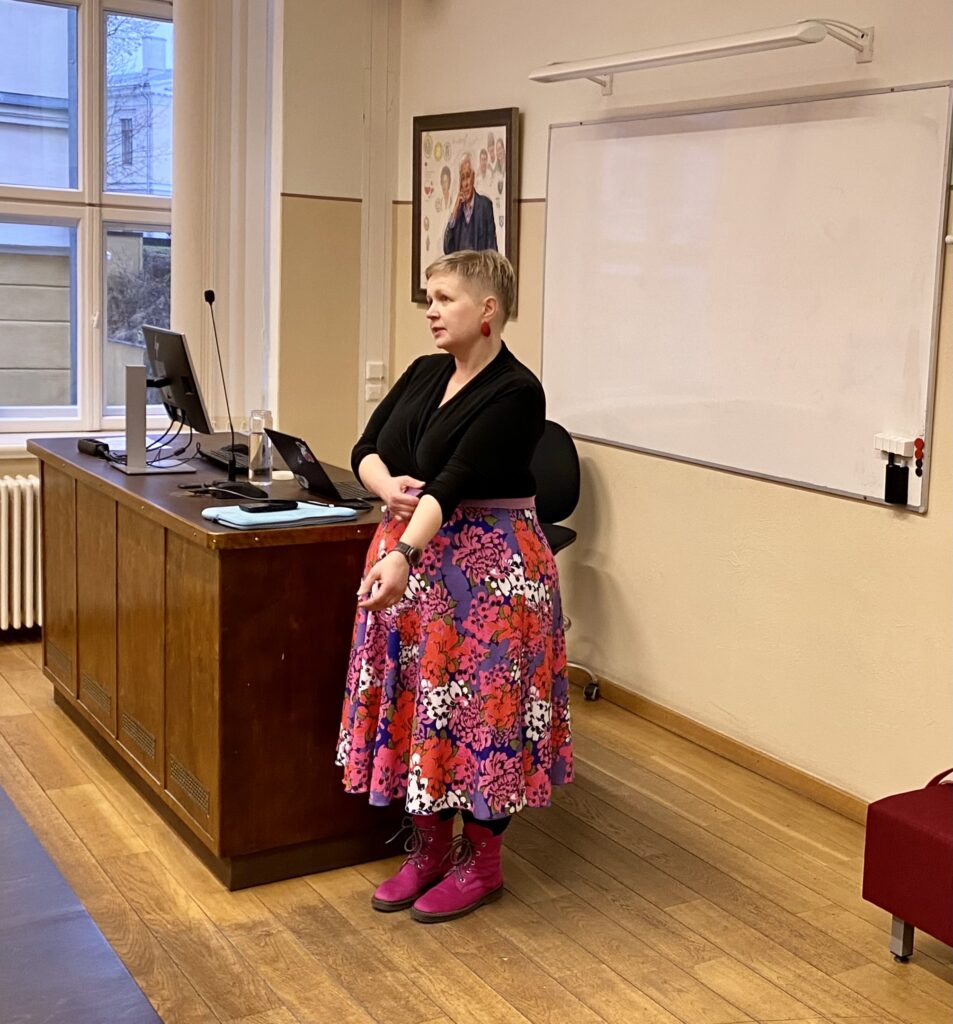
Cybersecurity expert Liisa Past during the lecture. Photo: Darja Maskin
On 8 December 2025, Liisa Past, a cybersecurity and strategic communications expert, gave a public lecture titled “Elections in a Fragile World: How Democracies Can Endure Strategic Manipulation”, examining how democracies can protect elections in an increasingly fragile and digitally mediated world. Drawing on global case studies and her extensive experience advising governments and election authorities, Past argued that while digital technologies have transformed elections, the core challenge today lies less in hacking votes and more in undermining trust.
Liisa Past emphasised that technology itself is neutral and should be understood as a tool rather than a threat. “Technology is neither good nor bad,” she said, stressing that its impact depends on how it is designed, governed and communicated. When implemented responsibly, digital systems can even improve transparency and oversight compared to purely paper-based processes.
A key message of the lecture was that no election system is fully secure. Instead, democracies should focus on resilience—making attacks difficult, risky ,and unlikely to succeed. “We are not aiming for 100 per cent security at all times,” Past explained. “What matters is that breaching the system is more costly for the attacker than any potential benefit.” She noted that politically motivated cyber actors differ from cybercriminals in that their primary goal is to delegitimise democratic processes rather than to profit financially.
The expert also highlighted the gap between how election administrators and the public tend to understand election security. While election officials focus on protecting core processes such as voter registration, voting and vote tallying, public debate often labels website defacements, data leaks or disinformation campaigns as “election hacking”. “Most of these incidents do not change a single vote,” Past noted, “but they can still succeed in creating confusion and doubt.”
Using examples from Albania, Malawi and Estonia, Past discussed voting machines, biometric registration and online voting systems, underlining the importance of audits, paper trails and voter education. Estonia’s experience with online voting, she argued, shows that trust is built over time and across services. “Elections cannot be the only digital service people use,” she said. “Trust forms when citizens interact with the state digitally in many areas of life—and elections become just one more familiar process.”
Beyond voting technology, Past stressed the importance of the wider election ecosystem, including population registries, result transmission systems and communication infrastructure. Weaknesses in these areas, she warned, can escalate into political crises even when votes themselves are counted correctly.
The lecture paid particular attention to information operations and strategic communication, which Past described as today’s most active layer of election interference. Referencing cases from Ukraine, the United States, Romania and Moldova, she showed how coordinated disinformation and inauthentic amplification can distort the information environment. The Romanian presidential election of 2024, where the first round was annulled due to foreign interference, marked a turning point. “For the first time, a court ruled that what happens in the information space can have such a major impact on elections,” Past said.
Concluding her lecture, Past argued that because attackers are adaptive and opportunistic, democratic defences must be comprehensive. “There is no single technological fix,” she said. Long-term investment in critical thinking, independent journalism and transparent communication remains essential to safeguarding elections in a digital age.
Liisa Past (MA, CISSP) is a cybersecurity and strategic communications expert widely recognized for her leadership in strengthening the digital foundations of democracy. As Estonia’s National Cyber Director, she coordinated cybersecurity policy across government and society, advancing whole-of-nation resilience in the world’s most digitally advanced democracy.
Liisa has served as an election technology expert on EU and OSCE/ODIHR election observation missions across three continents and has advised governments and international organizations on information security and digital resilience. As a Next Generation Leader at the McCain Institute at Arizona State University, she focused on securing elections and democratic technologies. She played a central role in Estonia’s first comprehensive election risk assessment and served as the lead editor of the EU’s inaugural Compendium on Cyber Security of Election Technology.
The lecture was moderated by Piret Ehin, Professor of Comparative Politics.
The event is organized in the framework of the Jean Monnet Centre of Excellence project REPAIR (grant agreement 101085795) in collaboration with the University of Tartu anti-disinformation platform.



